The memory of St. Kalnik, Patriarch of Constantinople
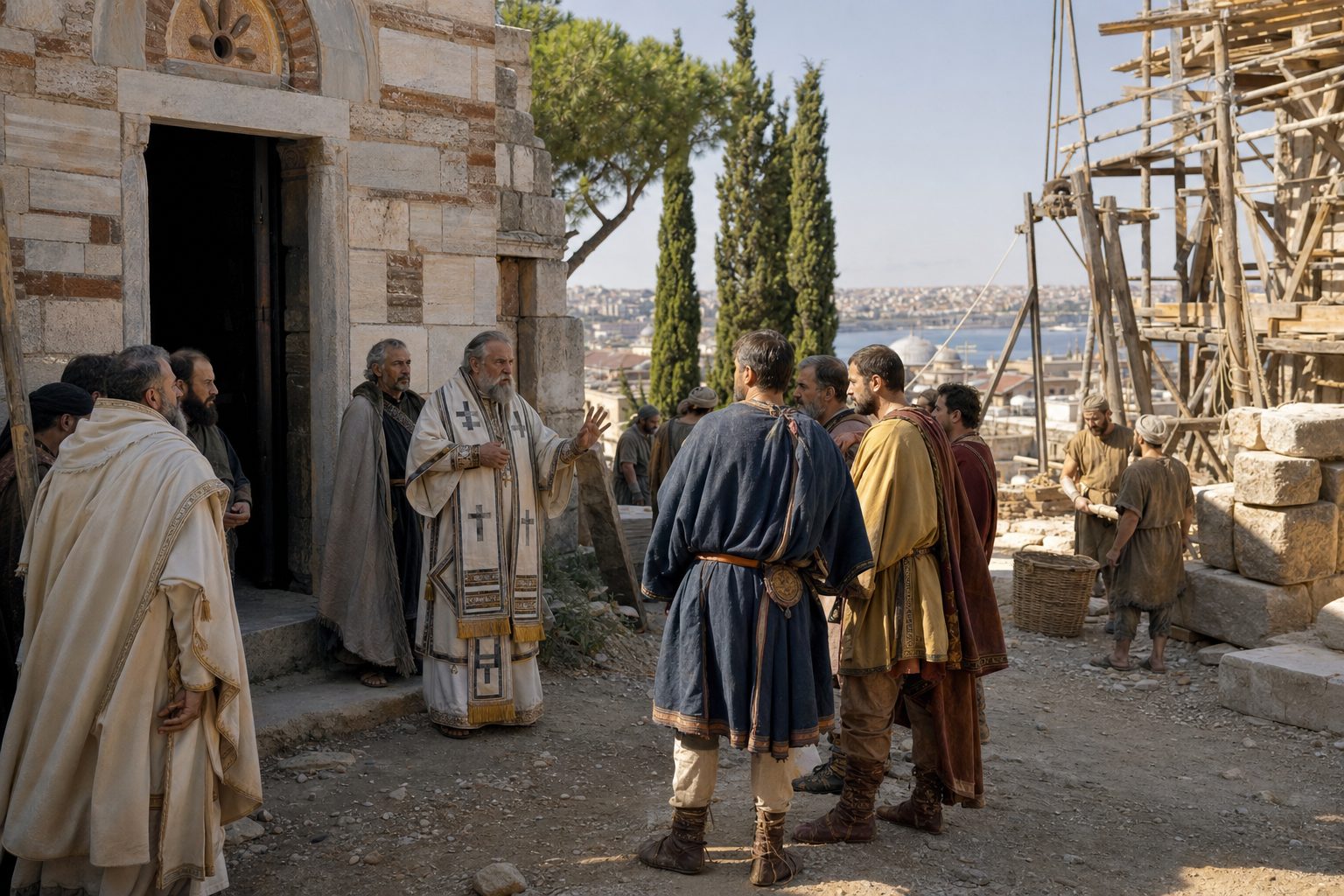
St. Callicus was originally a priest and vessel keeper of the Vlachern [Vlachern <unk> area in Constantinople, located in the western corner of the city; famous for its shrines.
<unk> 474 A.D.), at which the holy robe of the Most Holy Virgin, brought from Palestine, was placed in this church; the memory of this event is celebrated by the Church on July 2 (under this number you can read the narrative about the said event). <unk> Subsequently this church burned; now only small remains of it can be seen.]
It was during the reign of Justinian II, a wicked and ungodly king who oppressed many (Christians), did not respect the spiritual rank and did not honor the temples of God.
Near the palace there was a temple erected in the name of the Holy Mother of God; this temple was called the metropolitan. Since one of the walls of the palace, built by order of Emperor Justinian, had to be led past the mentioned temple, the emperor thought to demolish it.
The emperor ordered the patriarch to offer a prayer of blessing for the demolition of the mentioned temple. But the patriarch resisted the king, saying: <unk> I have no prayers for the destruction of the temple; on the contrary, I have prayers for the foundation and construction of the temple, for God created the world to be, not to be destroyed.
And the temple fell in that hour, and the king himself was cast out of his kingdom in disgrace, and his palace was made for another to dwell in, and the judgment of God was upon him.
When the emperor heard that the inhabitants of Constantinople were murmuring against him, as they did not like him for his frequent oppressions and his lawless life, and heard that everyone in the city spoke badly of him, he was filled with anger and fury against the whole city; then he ordered the patricians [the patricians in antiquity were called people of noble origin; they were usually entrusted with the most important public positions] and the voivode Stephen, the husband of a cruel, merciless man.
to prepare armed warriors and, in the coming night, suddenly attack the noblest citizens and kill them all without mercy.
At that time there lived in Constantinople a voivode named Leontius, who had gone to the East, and had shown great bravery in the war, and defeated many enemy regiments; but instead of honour and praise, he was imprisoned by the king for three years.
And when he heard of the king's wickedness, and of the king's commandment, he told it secretly to some of his friends, and they told it to their friends, and they gathered themselves together in a great multitude, and they armed themselves, and went to the king's palace.
When the soldiers saw that the king was asleep, they took him and bound him. Immediately, Leontius opened all the prisons, brought out all the prisoners, armed them, and sent them throughout the city. They went through the city and shouted, "Christians, gather yourselves together to the temple of St. Sophia, for King Justinian has been defeated and bound". When they heard this, they all went to the temple with great joy, saying, "This day the Lord has made; let us rejoice and be glad in it".
When the day came, Leontius led the king bound to the place where the horse-riding was customary; in the presence of all the people who had gathered there, he cut off the king's nose and sent him into captivity to Hersones [Hersones or Kherson (ancient Russian: Корсунь) <unk> the ancient name of the present peninsula <unk> Crimea]; from then on, Justinian was nicknamed "Korkonos" [Greek: <unk> "with the cut off nose"].
The inhabitants of Constantinople immediately proclaimed Leontius king, and his crown was given to him by the most holy patriarch, Kallicus, who reigned for three years, but was then banished by the voivode, Apsimar, whom the soldiers elected as emperor and named Tiberius III. Apsimar, taking Leontius, sent him into exile to the Dalmatian monastery, and he reigned for seven years.
At this time Justinian Corconos fled from Chersonese from captivity, and went first to the Khazars, and then to the Bulgarians; having gathered a large army from the Bulgarians, Justinian went to Constantinople and stopped at the Golden Gate [Location in Constantinople].
And it came to pass, when he was come into the city, that the people of the city were afraid of him; and they took him, and cast him into the sea, and he died there.
Then Justinian sent ambassadors to the most holy patriarch, Callinicus, and to the whole synclyte [the Synclyte <unk> council, composed of the oldest, most honorable citizens (and representatives of the highest spiritual authority).] begging him to receive him and promising by oath not to cause any offense to anyone.
The patriarch and the synclyte, after a council, proposed to Justinian that he would rob the holy cross of the Lord, the holy Gospel and the Pure Mysteries of the Body and Blood of Christ, so that by robbing him he would confirm his oath, <unk> namely, not to avenge his former exile on anyone.
And when the king came into the city with his army, and had taken the kingdom, he broke his oath at once, and was grieved, and began to slay many of the persons that stood in the synagogue, and also the other nobles of the city; and he commanded that Leontius of Dalmatia, who had driven him out, should be brought out of the palace; and his soldiers also took Apsimar of Apollonia, and brought them to him; and he commanded that both of them should be bound with shame in the midst of the city.
When they had brought them, and cast them at his feet, he stepped on their necks, and beat their heads, and his soldiers shouted, "You shall tread upon the scorpion and upon the dragon; you shall tread upon the lion and upon the dragon".
Justinian then seized the most holy patriarch, Callinicus, gouged out his eyes, cut off his nose and tongue, and sent him to Rome to be confined, where he ordered him to be put in a stone wall.
The king's command was carried out, and St. Callinicus was walled up in the wall, but after forty days the wall fell, and St. Callinicus was still alive, though he was barely breathing.
At this time, the holy supreme Apostles Peter and Paul appeared to Pope John VI in a dream and ordered him to bury the body of the holy patriarch Callicus in their apostolic church.
But the oath-breaker and torturer, Emperor Justinian Corconus, did not escape the just judgment of God. Not bearing his inhuman oppression, the citizens and military commanders conspired against him and, choosing an opportune time, attacked him and cut off his head.
I 'm not going to tell you .